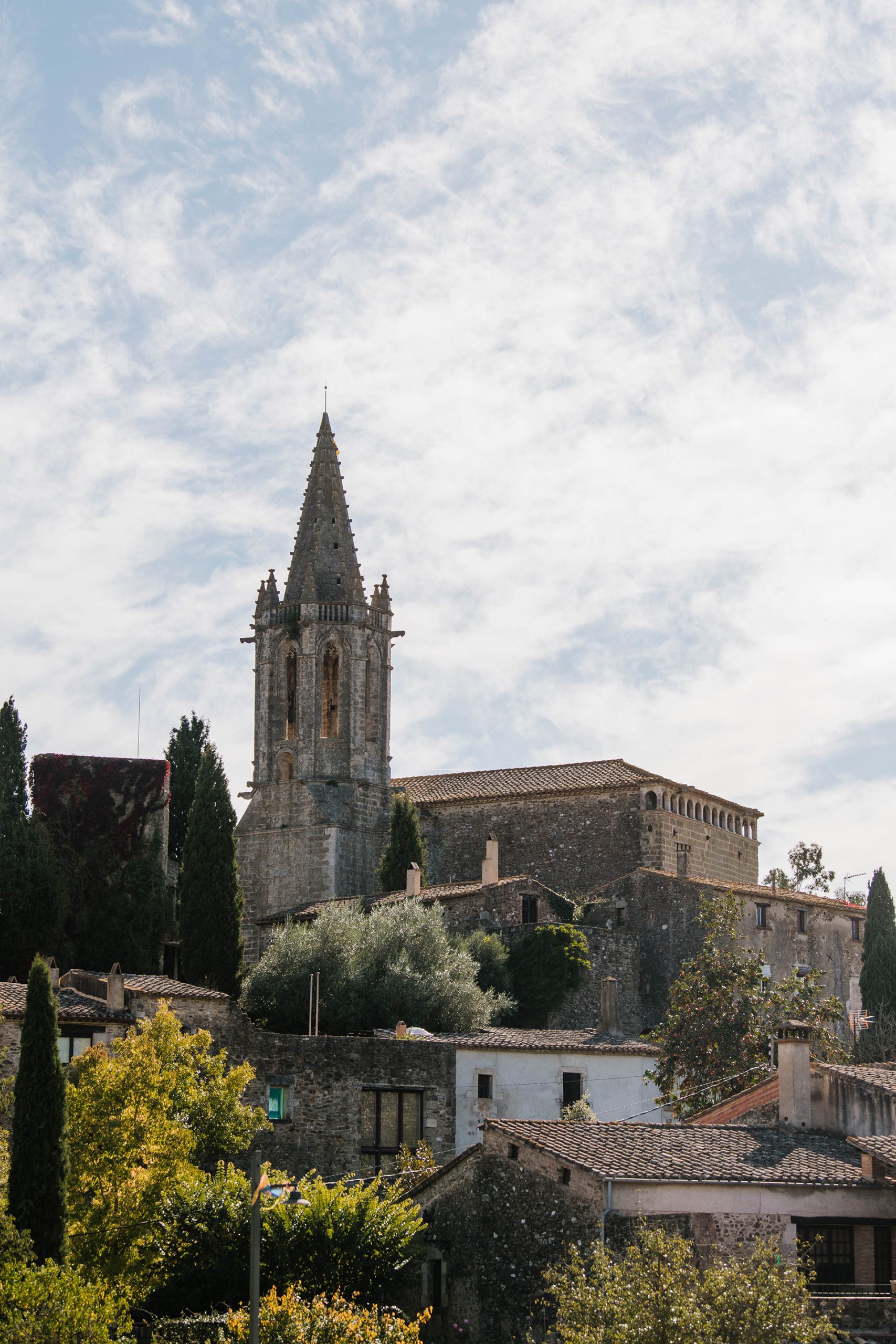
The current church of Sant Martí Vell dates from the 16th century, although it was already documented in 1035 in the will of Gilabert de Cruïlles. It was built over an earlier Carolingian-style church, still visible next to the bell tower. In 1229, it is mentioned in a feudal homage by Berenguer de Mazala to Guillem de Sant Climent. In 1372, the redemption of the “bovatge” tax is recorded under the reign of Peter III. In 1691, it is cited in the Diocesan Synod. In 1963, the rector Enric Bahí relocated the cemetery, and 18th-century elements were discovered.
The building has a single nave, divided into three sections, with four side chapels and a polygonal apse. The ribbed vault features sculpted keystones dated 1589 and 1590, and corbels with lion figures. On the outside, the Renaissance façade includes a portal with a triangular pediment supported by columns on plinths. At the top, there is a rose window and a gallery of twelve semicircular arches running along the façade. To the right, there is a sundial from 1588 and a 14th-century inscription. The bell tower, attached to the apse, has a square base, an upper octagonal body, pointed windows framed by pilasters with pinnacles, and a pyramidal roof.
In 2012, a comprehensive restoration was carried out, largely sponsored by the Elsa Peretti Foundation. Today, the church is on loan to the Town Hall and is used not only for liturgical celebrations but also as a venue for concerts and other cultural events.
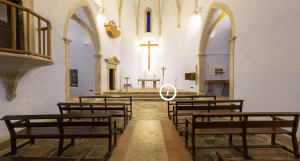
CLICK TO VIEW THE 360º VIRTUAL TOUR
With the support of the Generalitat de Catalunya.

In collaboration with the Diocese of Girona.